Can ultrafast lasers help in killing microbes?
Publication date
Addressing a timely question
During these challenging times, many people have asked us: Can ultrafast lasers be used to help combat the COVID-19 virus?
We don’t claim to be microbiologists, but there are certain studies showing how femtosecond lasers (such as the Fluence Jasper) could possibly help out in the fight against this deadly virus.
Creating antifouling titanium surfaces
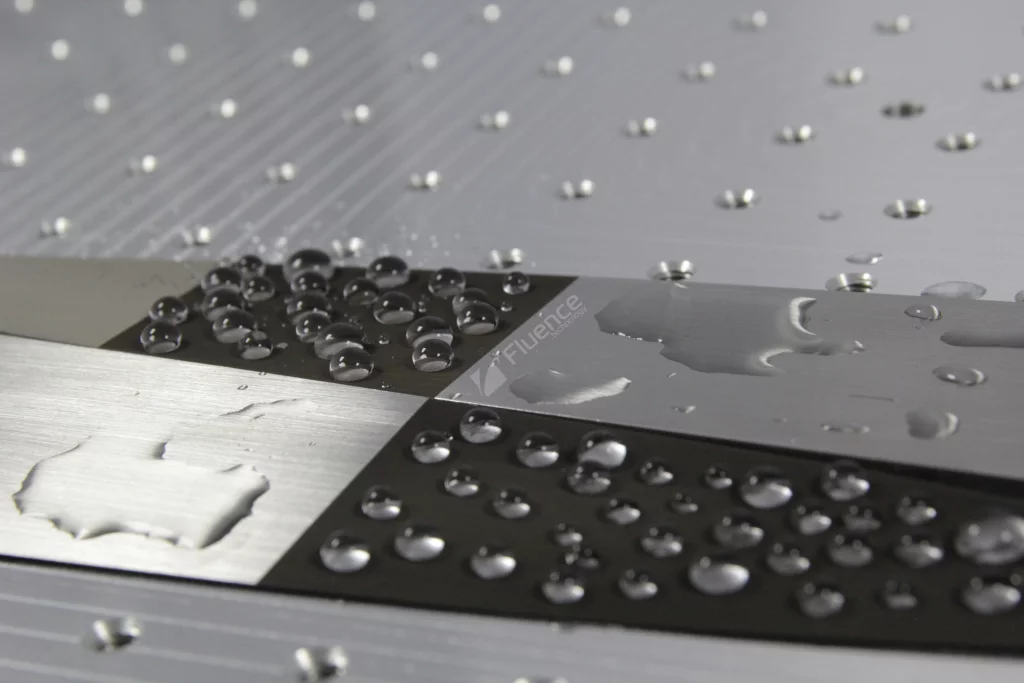
Firstly, there is an interesting study written by Fadeeva et al. (2011). The study shows that superhydrophobic microstructures on a titanium surface can create antifouling properties – preventing certain bacteria strains from being able to attach to this surface. Those superhydrophobic structures can be made with a femtosecond laser, like the Fluence Jasper, as shown in our video.
Similar results were obtained in a study by Shaikh et al. (2019) conducted on titanium and titanium alloys.
Combining laser structures with silver particles
A different approach is taken by Cai et al. (2019). Cai joins the use of ultrafast laser-generated microstructures with silver particle deposition in order to create highly effective antimicrobial surfaces.
Enhancing the natural properties of copper
Finally, there is some fascinating research on copper, completed by Zeiger et al. (2014). It is well-known for copper to have natural antimicrobial properties. Zeiger’s research shows that laser surface structuring can further enhance and boost this inherent capability.
A structural defense against transmission
The above studies show that although ultrafast lasers would not be used directly to kill the virus, they can be used to create microstructures on which the virus would struggle to exist.
Those special surfaces could be very useful in combating the transfer of pathogens through touch. With the manufacture of products such as structurally-enhanced door knobs, handles, and utensils, there is some hope that we can at least limit the transmission of viruses like COVID-19.